Amalfi Founder Anthony Marguleas
By ANTHONY MARGULEAS
Los Angeles voters will decide on November 3 whether to create a one-time Measure ULA exemption for qualifying properties damaged or destroyed in the Palisades Fire.
On November 3, 2026, Los Angeles voters will consider Proposition TE, officially titled “Property Transfer Tax Exemption for Victims of the January 2025 Fire Disaster.”
To understand Proposition TE, it helps to understand Measure ULA. Approved by Los Angeles voters in 2022 and implemented in 2023, ULA is an additional real estate transfer tax on higher-value property transfers that funds affordable housing and homelessness-prevention programs. It is commonly referred to as the “mansion tax.”
I support providing relief to Palisades fire victims. For a family whose property qualifies and whose sale would otherwise be subject to ULA, Proposition TE could save hundreds of thousands of dollars.
The question is: How many Palisades fire victims will actually benefit?

Palisades Land-Sale Data:
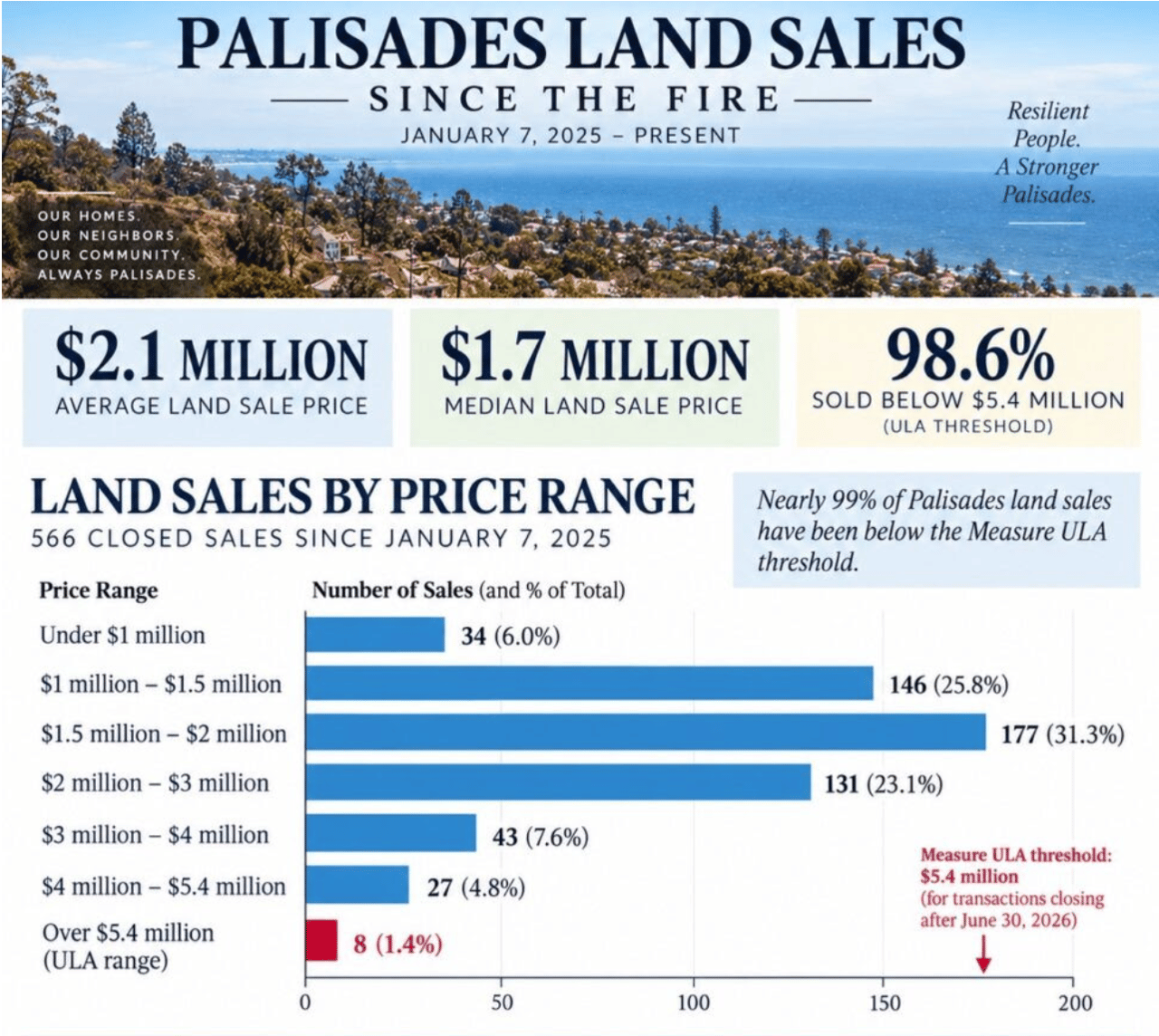
Since the January 7, 2025, fire, I have tracked 566 closed Palisades land sales. The average sale price was approximately $2.1 million, the median was $1.7 million, and approximately 80% sold below $3 million.
Most significantly, only 8 transactions—1.4%—exceeded the ULA threshold applicable when they closed. In other words, 98.6% were already at or below the threshold.
The “$5 Million Mansion Tax” Isn’t Really $5 Million Anymore.
Many people still assume Measure ULA begins at $5 million because that was its original lower threshold. But the threshold is adjusted annually for inflation based on the Bureau of Labor Statistics Chained Consumer Price Index.
For transactions closing after June 30, 2026, the lower threshold is $5.4 million. The current ULA rate is 4% for qualifying transfers above $5.4 million and below $10.9 million, and 5.5% at $10.9 million or more.
That’s why our analysis compared each land sale with the ULA threshold in effect when that transaction closed, rather than applying today’s $5.4 million figure to every sale.
For those who do qualify, the savings can be substantial. At the current 4% rate, for example, a qualifying $6 million transaction could otherwise face approximately $240,000 in ULA tax.
Voter Approval Needed.
The City’s stated rationale for the exemption is that ULA can create an additional financial burden for some fire-affected owners who need or want to sell. The proposal is intended to provide targeted relief to qualifying fire victims whose transactions would otherwise trigger the tax.
Voter approval is required because this particular exemption cannot simply be enacted administratively as an ordinary change to the tax.
For qualifying families, that relief could clearly be meaningful. But the land-sale data suggests its impact on burned-lot sellers will be relatively narrow.
What about Homes That Didn’t Burn?
This may be the more important unanswered question.
Proposition TE applies to qualifying residential properties “damaged or destroyed” by the Palisades Fire—it is not limited to homes that completely burned down.
Consider the Riviera, where many homes remained standing, and some experienced little or no apparent fire-related damage. Would documented smoke or ash contamination qualify as “damage”? Is there a minimum level of damage? What documentation would an owner need?
Conversely, would a standing home with no documented fire-related damage qualify simply because it is located in Pacific Palisades?
The “damaged or destroyed” language raises these practical eligibility questions, and homeowners deserve clear guidance from the City before the election.
What if Someone Buys a Burned Lot and Rebuilds?
Another important distinction arises when considering Proposition TE as part of the broader Palisades recovery.
The measure is intended as a one-time exemption for qualifying fire-affected owners, rather than a permanent exemption attached to Palisades properties.
Someone who purchases a burned lot today, invests millions of dollars to rebuild a home, and eventually sells the completed property should not assume a future sale will receive the exemption.
That distinction matters because providing financial relief to a fire victim who needs or wants to sell is different from creating a broader economic incentive to encourage investment and rebuilding throughout the Palisades.
Questions That Still Need Answers.
Proposition TE could provide meaningful relief to qualifying families. But the post-fire land-sale data suggests its impact on burned-lot sellers will be relatively narrow.
The larger unanswered question is how many owners of surviving homes—including those with smoke or ash damage—will qualify.
Before voting on November 3, Palisadians deserve clear answers on the following questions: 1) What constitutes fire damage? 2) Does documented smoke or ash contamination qualify? 3) Is there a minimum level of damage? 4) What documentation will owners need? 5) Is there a defined geographic boundary? and 6) How many Palisades property owners does the City estimate will actually qualify?
Those answers would give voters a much clearer understanding of exactly who Proposition TE would help. CTN reached out to Councilmember Traci Parks office for clarification, as soon as there is a response, the story will be updated.
Readers can review Proposition TE through the Los Angeles City Clerk’s official ballot-measures page and the current ULA thresholds and rules through the Los Angeles Office of Finance Measure ULA page.